
Living paycheck to paycheck is often described as a financial condition, but in reality, it is an emotional one. It is the knot in your stomach when an unexpected car repair bill arrives. It is the anxiety of watching the gas gauge approach empty with three days left until payday. It is the quiet envy of watching friends book vacations while you calculate if you can afford a night out.Guide to Stop Living Paycheck to Paycheck
Contrary to popular belief, this isn’t just a problem for the low-income bracket. A significant portion of middle-class earners find themselves in this cycle. According to various market reports, a large percentage of consumers—regardless of salary—spend nearly all of their monthly income.
The definition of “paycheck to paycheck” is simple: Your expenses consume 100% (or more) of your income. There is no buffer. There is no “float.” There is only the relentless cycle of earning, spending, and waiting.
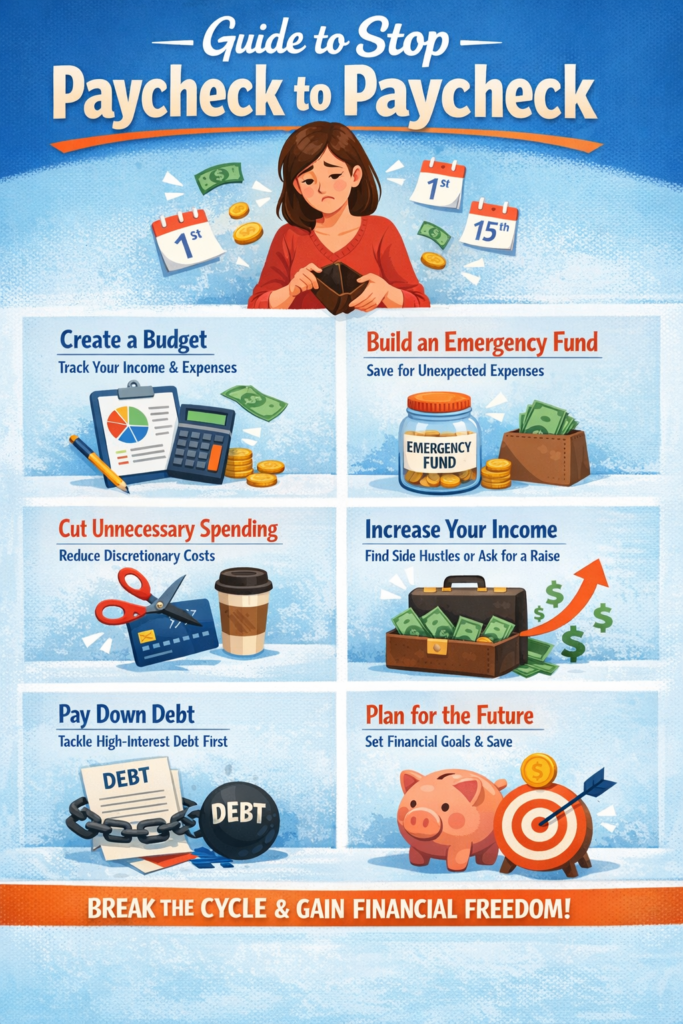
Escaping this trap requires more than just a budgeting app or a vague promise to “spend less.” It requires a psychological shift and a structural overhaul of your finances. Here is your step-by-step escape plan.
Phase I: The Diagnosis (Before You Can Fix It, You Must See It)
Most people don’t know exactly where their money goes. They have a general idea—”I spend too much on food” or “Rent is killing me”—but vagueness is the enemy of progress.
Step 1: Conduct a Financial Audit (The 15-Minute Shock Therapy)
You need to look at the last 30 to 90 days of spending. Not your estimates, but the actual data.
- Gather the evidence: Bank statements, credit card bills, Venmo/Cash App histories.
- Categorize: Separate your spending into three distinct buckets:
- Fixed Essentials: Rent/Mortgage, Utilities (base), Insurance, Minimum Loan Payments.
- Variable Essentials: Groceries, Gas, Medicine.
- Non-Essentials: Dining out, subscriptions, entertainment, hobbies, premium brands.
The goal here is not judgment; it is data collection. You are a scientist observing a subject (yourself). Look for the “leakage”—the small, recurring expenses that have flown under the radar.
Step 2: Calculate Your “Freedom Number”
Your Freedom Number is the gap between your income and your essential expenses. It answers the question: If I had to survive on absolute necessities for one month, how much money would I have left over?
This number is your potential. If that number is negative, you have a structural deficit. If it is positive, you have a behavioral problem (you are spending the surplus on things you don’t need).
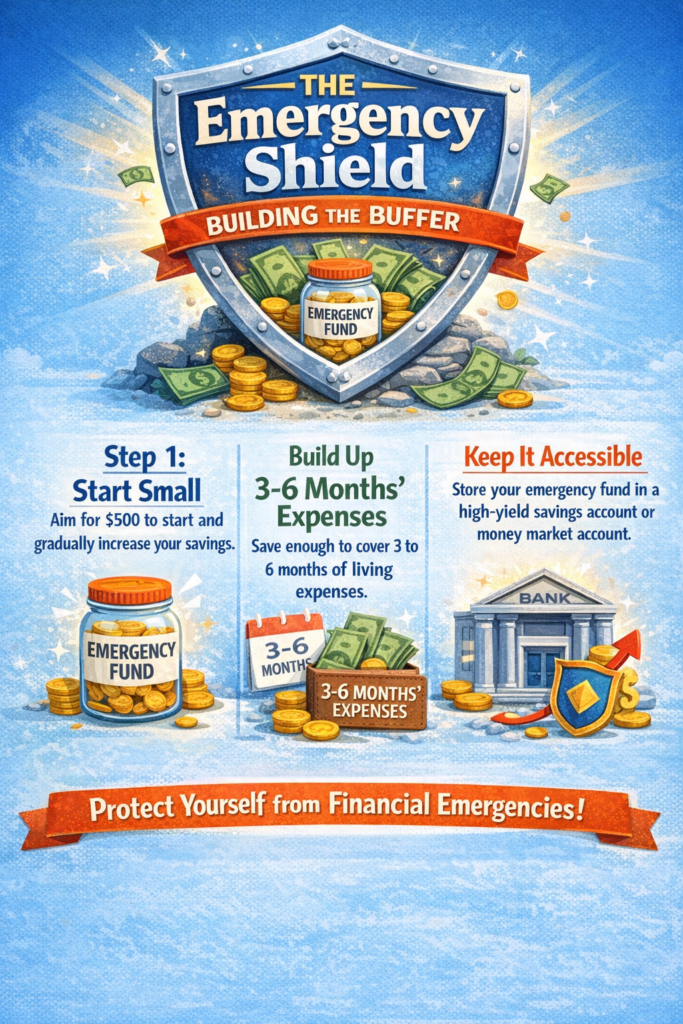
Phase II: The Emergency Shield (Building the Buffer)
The primary reason people stay in the paycheck-to-paycheck cycle is the “Oh Shift” moment. The car breaks down, the dog gets sick, or the kid needs school supplies. Since there is no savings, the solution is credit. You put the $500 repair on a credit card. Now, next month’s paycheck isn’t just for next month’s bills; it’s for last month’s bills, plus interest.
You cannot start investing or saving for long-term goals until you break this cycle of debt-fueled emergencies.
Step 3: The $1,000 Mini-War Chest (The First Goal)
Forget the standard advice of a 3-6 month emergency fund for now. That can take a year to build, and you need relief now. Your immediate goal is $1,000 cash in a savings account. This is your shock absorber.
- How to raise it fast:
- The 7-Day Sell-Off: Look around your house. The treadmill you hang clothes on, the old gaming console, the designer bags you don’t use. List them on Facebook Marketplace or Craigslist today. Price them to sell (80% of new retail). You want cash, not top dollar.
- Side Gig Intensity: Drive for a rideshare, deliver food, or do TaskRabbit for one week. Tell yourself this is a sprint, not a marathon. You are simply trying to raise that $1,000 shield.
Once you have this shield, you promise yourself: This money is for true emergencies only. A flat tire? Yes. Concert tickets? No.
Phase III: Restructuring the Cash Flow (The Art of the Paycheck)
Now we get to the mechanics. How do you ensure that when money comes in, it doesn’t immediately fly out?
Step 4: Abolish the “Leftover” Method
Most people practice “Spend-first-save-later.” They pay bills, spend on daily life, and hope something is left at the end of the month. Nothing is ever left.
You must switch to the “Set-it-and-forget-it” Method.
- Open a separate bank account. This cannot be the same account you use for your debit card. Ideally, it should be at a different bank entirely (to prevent instant transfers).
- Automate a transfer. The day after you get paid, set up an automatic transfer of $25 or $50 to this separate account. It doesn’t matter if it’s a small amount. What matters is that you are establishing the habit that you are not a slave to your income.
- The Psychology: This forces you to live on 95% of your income instead of 100%. You will adapt. Humans are remarkably good at adjusting to new constraints. If you have less money in checking, you naturally find ways to spend less on coffee or takeout.
Step 5: The “Anti-Budget” (Reverse Budgeting)
Traditional budgets require you to track every penny, which is exhausting and unsustainable for most people. Instead, use a “Reverse Budget” or “Priority-Based Budget.”
List your priorities for the month in this order:
- Shelter & Transportation: Rent and gas to get to work.
- Utilities & Food: Keep the lights on and food in the fridge.
- The “Mini-War Chest” Contribution: That automatic transfer we just set up.
- Debt Obligations: Minimum payments on cards and loans.
- Everything Else: Whatever is left is yours to spend guilt-free.
Notice that “Everything Else” comes last. If you run out of money for entertainment halfway through the month, you stop spending on entertainment. You don’t steal from the rent money.
Phase IV: Negotiating the Status Quo (Cutting the Fat)
You now have a system, but the system runs on the fuel of your income. If your expenses are too high, the system breaks. You must go on the offensive against your current bills.
Step 6: The Bill Reduction Blitz (One Afternoon of Work)
Pick one afternoon this weekend. Make a list of every service you pay for: Internet, cell phone, insurance (car, renters), and subscriptions.
- Call and Negotiate: Call your internet/cable provider. Use the phrase: “I’m reviewing my budget and looking to cut costs. Can you review my plan and see if there are any current promotions or lower-tier options?” Companies retain customers better than they acquire new ones. They will often lower your rate just to keep you.
- The “Bundle” Trap: Do you need 200 Mbps internet for one person? Probably not. Downgrade the speed.
- Insurance Audit: Call your auto insurer. Ask if there are discounts for good driving, low mileage, or bundling with renters insurance. Get quotes from competitors. Switching insurers can save you hundreds instantly.
Step 7: The Subscription Autopay
Go to your phone settings (App Store subscriptions on iPhone, Google Play on Android) and look at your active subscriptions. You likely have:
- A streaming service you haven’t used in 3 months.
- A gym membership you haven’t visited since January.
- A meditation app you forgot about.
- A box subscription for a hobby you quit.
Cancel them. All of them. You can always re-subscribe later if you genuinely miss them. This isn’t about deprivation; it’s about eliminating waste.
Phase V: The Income Escalator (Widening the Gap)
You can only cut expenses so far. There is a floor to survival. If you have trimmed the fat and are still struggling, you have an income problem. The goal now is to widen the gap between what you earn and what you spend by increasing the “earn” side.
Step 8: The Skill Investment
Instead of trading your time for money in a low-paying side gig forever, look for ways to increase your primary income.
- The Career Conversation: Go to your boss with a list of your accomplishments. Frame it not as “I need a raise,” but as “I want to take on more responsibility. Here is the value I’ve added; here is what I can do next. What would a compensation package look like for that expanded role?”
- Upskilling: Identify one skill that would make you more valuable. Is it learning Excel? Getting a project management certification? A sales technique? Spend 30 minutes a day learning it. A $1/hour raise is an extra $2,000 a year for a few hours of study.
Step 9: The “Micro-Business” Mindset
Look at your hobbies. Can they generate income?
- Are you good at organizing? Offer closet-organizing services on the weekend.
- Do you bake? Sell to neighbors or at a local farmer’s market.
- Are you handy? Use TaskRabbit.
The goal isn’t to become a millionaire overnight. The goal is to generate a small surplus ($100-$200 a month) that gets funneled directly into your emergency fund or debt payoff.
Phase VI: Psychological Warfare (The Mindset Shift)
The biggest barrier to escaping the cycle is often ourselves. We have ingrained habits and a sense of entitlement to our current lifestyle.
Step 10: Delayed Gratification Training
Living paycheck to paycheck is often a result of seeking immediate comfort. We buy the latte now because the future feels abstract.
- The 48-Hour Rule: For any non-essential purchase over $50, force yourself to wait 48 hours. Put it in an online cart and walk away. You will likely find that the “need” for the item vanishes within two days.
- Unsubscribe from Temptation: Unsubscribe from marketing emails. If you don’t see the sale, you can’t be tempted by the sale. Retailers spend billions to make you feel like you need things. Block the signal.
Step 11: Define Your “Why”
Sacrifice without a goal is just suffering. You need a compelling reason to skip the takeout and cancel the subscription.
- Do you want to sleep soundly at night?
- Do you want to be able to quit a job you hate?
- Do you want to take a real vacation next year?
- Do you want to be able to help your parents if they fall on hard times?
Write this “Why” down. Put it on your bathroom mirror. When you are tempted to spend money you don’t have, look at that note. Is the fleeting pleasure of this purchase worth more than your “Why”?
Phase VII: Breaking the Debt Cycle (The Final Boss)
If you have existing credit card debt, you are fighting a war on two fronts. You are trying to save while also paying interest.
Step 12: The Debt Snowball or Avalanche
You need a strategy to kill the debt. There are two primary schools of thought:
- The Snowball: List debts from smallest to largest. Pay minimums on everything, but throw every extra penny at the smallest debt first. Once that’s gone, roll that payment into the next smallest. Why it works: It provides quick psychological wins.
- The Avalanche: List debts from highest interest rate to lowest. Pay minimums on everything, but attack the highest interest debt first. Why it works: It saves you the most money in the long run.
Choose the method that keeps you motivated. The best financial plan is the one you stick to.
Step 13: The “No New Debt” Pledge
While you are implementing this plan, you must go cold turkey on new consumer debt. The credit cards stay in the drawer (or frozen in a block of ice in the freezer, a famous trick). If you don’t have the cash for a “want,” you don’t buy it.
The Long View
Escaping the paycheck-to-paycheck cycle is not a quick fix. It is a process of reclaiming your future from the demands of the present. In the first month, you might only save $100. That’s a victory. In the third month, you might pay off a small credit card. That’s a victory. In the sixth month, you might have $1,500 in the bank and the feeling of a weight lifting off your chest.
You are not looking for a life of deprivation. You are looking for a life where money is a tool, not a tyrant. You are looking for the freedom to say “no” to a job you hate, or “yes” to an opportunity that scares you, simply because you have a buffer.
Start today. Audit your spending. Build the $1,000 shield. Automate your savings. The only way out is through, and the first step is the most important one.